
Above-ground pipelines
Closed cell on exposed pipe and fittings to hold product temperature and keep condensation off the steel.
Above-ground pipelines, tanks, utility buildings, site enclosures and foam trench breakers for oil and gas work across Alberta and Saskatchewan.
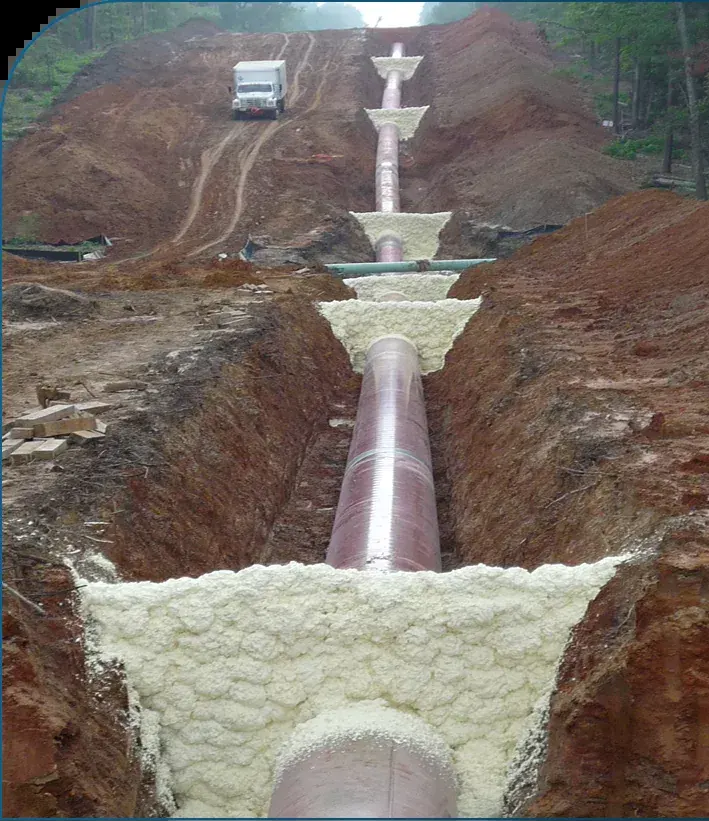 Pipeline trench breakers
Industrial spray foam is closed cell polyurethane foam applied to pipelines, tanks, utility structures and site buildings to insulate steel, control condensation and, in trenches, stop water from washing out backfill. Aires handles this work for oil and gas sites across Alberta and Saskatchewan.
Industrial foam work isn't like spraying a basement. Sites are remote. The steel might be at -40°C in January or too hot to touch in July. The work has to fit around operations, other contractors and site safety rules. Pipeline and facility jobs are a regular part of our work, and we sort out the logistics before mobilization.
A trench breaker is a foam dam built across a pipeline trench before it's backfilled. It wraps the pipe and fills the trench wall to wall.
Once a pipe is buried, the loose backfill around it is softer than the undisturbed ground on either side. Water finds that soft path and runs along the pipe, especially on a slope. Over time it carries the backfill away, opens voids under the pipe and erodes the right-of-way. A series of trench breakers down the slope cuts that channel into short sections, so water can't build up speed or volume.
Foam works well for this because it expands to fill the irregular trench shape, bonds to the pipe coating and the soil, and goes in quickly once the pipe is in place.
These are the main types of jobs. If yours isn't here, describe it and we'll tell you if foam is the right fit.
Closed cell on exposed pipe and fittings to hold product temperature and keep condensation off the steel.
Foam sprayed on the shell and roof of storage tanks, with a protective coating over it for weather and UV.
Pump houses, meter buildings and equipment shelters where electronics and valves need to stay above freezing.
Steel and modular site buildings, including skids and shacks, insulated so heaters keep up through winter.
Foam dams in open pipeline trenches to control water flow and protect backfill on slopes.
Bare steel in a heated or humid space gets wet every time the outside temperature drops. Closed cell foam keeps that from happening.
When warm, moist air touches cold steel, water forms on the surface. Inside an enclosure that means dripping on equipment and controls. On pipe and tanks it means a wet surface that keeps coming back. Over time that water feeds corrosion.
Closed cell foam bonds directly to the steel. With no air gap behind it, moist air never reaches the cold surface. At about R-6 to R-7 per inch it also cuts heat loss, so you burn less fuel keeping a building or a line at temperature. Indoors, exposed foam often needs a thermal barrier, and we apply DC315 for that. Structural steel fire protection is covered under our fireproofing work.
Most of the work on an industrial job happens before anyone sprays.
Send us the location, the structures and the specs. We'll ask about access, power, water and site requirements.
Foam, coatings, mobilization, and any heating or hoarding the season calls for.
Our crew follows your site's orientation and safety rules before work starts.
Foam goes on to the specified thickness, with documented quality and safety checks.
Protective coatings go on where needed, the area is cleaned up and the rig heads to the next site.
Spray foam has working limits. The chemicals and the surface both need to be in a certain temperature range, and the steel has to be clean and dry. On a winter job in northern Alberta that can mean heating the substrate or putting up a temporary enclosure. In summer, hot steel in direct sun can cause problems too. We plan that into the quote instead of finding out on the day.
For buildings in town, such as warehouses and shops, see commercial spray foam. Farm and acreage work is on our agricultural spray foam page, and the full list of services is under insulation. All work carries a one-year workmanship warranty.
A trench breaker is a dam of foam built across a pipeline trench, around the pipe, before backfill. It stops water from running along the trench beside the pipe, which would otherwise wash out the backfill and erode the slope.
Yes. Closed cell foam bonds to steel and insulates it, which helps hold product temperature and keeps condensation off the metal. Exposed foam outdoors needs a protective coating over it, and we'll spec that with the job.
Yes. Our Alberta crews work across Alberta and Saskatchewan, plus BC and the Yukon on larger projects. Send the location and scope and we will quote mobilization with the work.
Foam has temperature limits for the surface and the chemicals. In winter we often heat the work area or the substrate first, or build a temporary enclosure. We'll tell you what the site needs once we know the conditions.
Spray foam is priced by the board foot (one square foot, one inch thick). Industrial quotes also account for travel, site access, coatings and any heating or hoarding needed. We provide a written quote for each scope.
Tell us what you're insulating and where. We'll book a walkthrough, measure it, and send you a written quote. Serving Edmonton, Calgary and across Alberta.